

Artificial intelligence (AI) has revolutionized the way we create and consume content. From blog posts to news articles, AI content is almost everywhere. A review made by news guard shows that we have over 957 plus (and counting) news and informational sites that have AI-generated content.
But how can you tell if what you’re reading was written by a human or an AI? Detecting AI content is becoming increasingly important for maintaining the integrity of information, ensuring ethical practices, and safeguarding intellectual property. In this article I will show you how to spot the difference
Table of Contents
Understanding AI Content
Definition of AI Content
AI content refers to any text, image, video, or other media created by an artificial intelligence system. These systems, such as GPT-4, use complex algorithms and vast datasets to generate content that mimics human writing.
Common AI Content Generators
At this time and error we have so many Ai Generated Content. Some of the most well-known AI content generators include Open AI’s GPT series, Gemini and Copilot used by Microsoft. These tools are capable of producing highly coherent and contextually relevant content, often indistinguishable from that written by humans.
Why Detecting AI Content Matters
Ethical Implications
AI-generated content can blur the lines between authentic and synthetic information. This raises ethical concerns about transparency and the potential for misinformation.
It is important to maintain transparency and disclose when content has been created by artificial intelligence, to ensure that consumers are not misled or manipulated.
Additionally, there is a need to address issues of bias and accuracy in AI-generated content, as algorithms can perpetuate harmful stereotypes or misinformation if not properly monitored and regulated. Moving forward, it is essential for stakeholders to carefully consider the ethical implications of using AI-generated content and strive to uphold integrity and accountability in the digital landscape.
Impact on Trust and Credibility
When readers come across articles or information that has been generated by AI, they may question the authenticity and reliability of the content. This can erode trust in the source and ultimately damage the credibility of the organization or individual associated with the content.
To maintain trust and credibility when using AI-generated content, it is essential for organizations to be transparent about the use of this technology and to ensure that the content is accurate, unbiased, and meets the highest standards of quality.
Read also: Understanding Prompt Engineering :Key concepts {Beginners Guide}
Legal and Copyright Issues
There are legal consequences associated with AI content, particularly regarding copyright and intellectual property rights. One of the main concerns is determining ownership of the content produced by AI. In traditional copyright law, the creator of the work holds the copyright.
However, with AI-generated content, it becomes challenging to determine whether the AI system or the individual who trained it owns the copyright. Another issue is ensuring that the content produced by AI does not infringe on the copyrights of others.
Companies must be diligent in understanding the source of the data used to train their AI systems to avoid potential copyright infringement. Additionally, companies need to be cautious when using AI-generated content for commercial purposes, as they could face legal consequences if they use copyrighted material without permission.
Ultimately, companies using AI-generated content should seek legal guidance to navigate the complex legal and copyright landscape to ensure compliance with the law.
Ways to Detect AI-Generated Content
Uniformity in Tone and Style
AI content often maintains a consistent tone and style throughout the text, they don’t use slang, they also don’t use informal language which can be a giveaway.
Human writers, however, frequently employ small stylistic differences in their work. Human authors won’t sound boring or repetitive since we’ll joke about and use pop culture references.
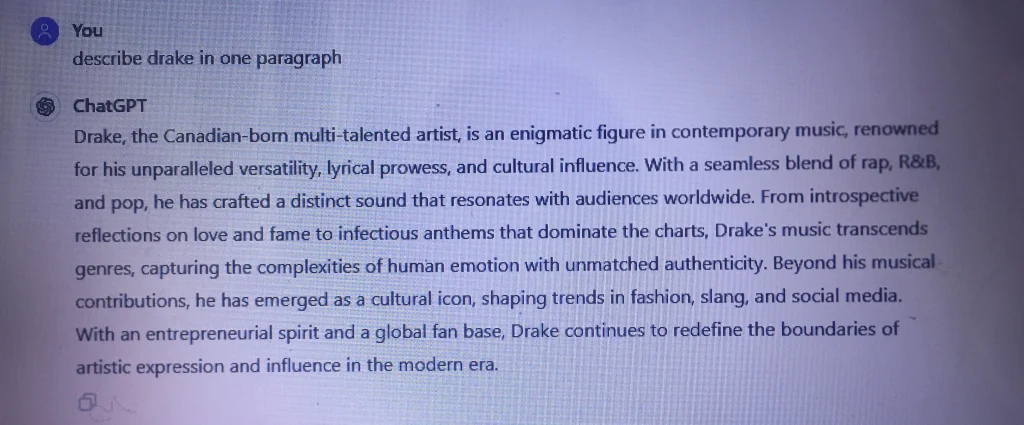
Take a look at this AI’s answer to a basic, direct question.
A human writer wouldn’t convey this information in such a formal or stiff manner.
Repetitive Phrasing and Vocabulary
AI systems use repetitive phrases or similar vocabulary repeatedly, lacking the creative diversity typically found in human writing. Hence they wont realize they are spinning the same tale over and over again.
Take an example of this snippet generated with Chat GPT in response to Transformational leadership. We can see its repeating the word ‘Transformational leaders’ several times:

Lack of Personal Experience or Emotion
AI content will lack the depth of personal experience or emotional engagement that characterizes human writing. It often feels detached or impersonal.
However, when writing, human authors frequently include thought-provoking and perceptive queries. They’ll talk about their experiences and personal insights.
Read also: Understanding Prompt Engineering :Key concepts {Beginners Guide}
Lack of Citation
Verifying the citation is another method on the list for spotting AI-generated content, particularly in research and academic works. This is because most AI tools provide inaccurate or arbitrary citations.
AI content frequently produce generalized, detail-free descriptions. Human authors enrich content with pertinent information and useful suggestions, particularly if they have first-hand knowledge of the subject.
Use of Excessive Ai Typical words/terms
We have all utilized AI in a variety of ways, and if you are paying close attention, you may have seen some of the words below when AI generates Content:
- Delve into
- Tapestry
- Bustling
- In summary or In conclusion
- Remember that….
- Take a dive into
- In the world of
- Realm
- Embark
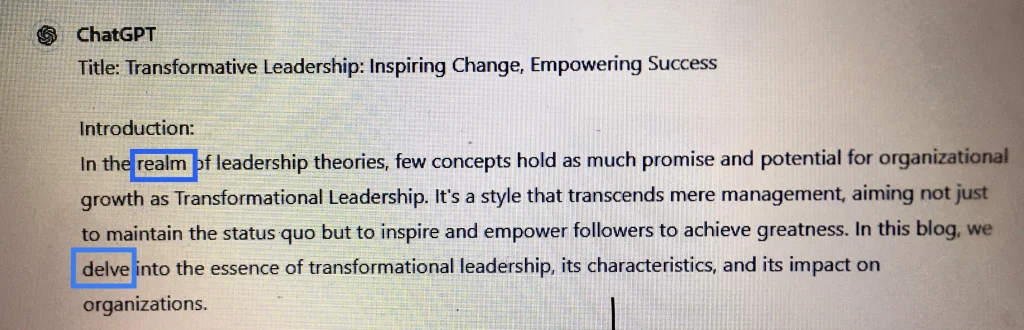
As we can see in this example below we have the use of Realm and Delve into
Assessing the Depth of Analysis
AI algorithms can find it difficult to replicate the in-depth knowledge and complex viewpoints that human writers can provide on a given subject. Human writers can draw on their creativity, personal experiences, and critical thinking skills to offer unique insights and interpretations that add depth to their content.
In contrast, AI content will skim the surface of a topic, presenting information without exploring the underlying complexities or providing substantial analysis.
While AI technology has made significant strides in natural language processing, it still lacks the human touch and perspective that makes human-written content engaging and thought-provoking.
Read also: Understanding Prompt Engineering :Key concepts {Beginners Guide}
Use AI Detection Tools
Numerous AI tools have been developed to detect AI content. These tools analyze text for patterns and markers indicative of AI generation.
Here are some of the tools you can use to detect AI generated Content:
1.QuillBot
Case Studies: AI Content vs. Human Content
Example 1: Blog Posts
A blog post by a human writer will include personal stories, varying tones, and unique perspectives. An AI-generated post could lack this personal element and might recycle phrases.
Example 2: News Articles
Human journalists typically provide thorough investigations, interviews, and original reporting. AI-generated news articles will miss these elements and focus on easily accessible information or even outdated news. Did you know that AI technologies or tools are not designed to update their knowledge base in real time, hence not prioritizing the most recent sources.
Example 3: Product Reviews
Human reviewers share personal experiences, pros and cons, and emotional responses. AI-generated reviews might seem overly neutral and lack personal anecdotes.AI will either summarize or paraphrase another person’s experience.
Best Practices for Avoiding AI Content
Creating Authentic and Original Content
Prioritize authenticity by incorporating personal stories, unique insights, and original research. This approach will distinguish your content from AI-generated material.
Using Multiple Sources and References
Citing diverse and reputable sources will add credibility to your content and make it more challenging for AI systems to replicate.
Regularly Updating Content
Keep your content fresh and relevant by regularly updating it. This practice not only improves SEO but also ensures that your information remains current and valuable.
Read also: Understanding Prompt Engineering :Key concepts {Beginners Guide}
The Future of AI Content Detection
Advancements in Detection Technology
As AI technology evolves, so do detection methods. Expect more sophisticated tools that can better identify AI-generated content.
The Role of Regulations and Guidelines
Regulations and industry guidelines may emerge to ensure transparency and ethical use of AI in content creation.
Ongoing Challenges and Solutions
AI content detection is a cat-and-mouse game. While technology improves, so do the capabilities of AI content generators. Continuous innovation and vigilance are essential.
Conclusion
Detecting AI content is crucial in maintaining trust, credibility, and ethical standards. With the rise of deep fakes and AI-written articles, it is crucial for organizations to invest in robust detection strategies to safeguard their online reputation and credibility.
Additionally People want real examples and real life experiences. This leads to more engagement either in your articles or blogs. However consider using AI as an assistant but don’t rely on it 100% rather let it be a guide on how to carry various steps.
I hope this blog was helpful. Don’t Forget if you have any questions, I will gladly answer them on the comment Section.
Read also: Understanding Prompt Engineering :Key concepts {Beginners Guide}
FAQs
1.What are AI content detection tools?
AI content detection tools are software applications that analyze text to identify patterns and markers indicative of AI generation. These tools use algorithms and machine learning to differentiate between human and AI-generated content.
2.Can AI content be completely avoided?
While it may not be possible to completely avoid AI content, you can minimize its presence by prioritizing human-written, authentic, and well-researched content. Regularly updating and cross-referencing your work also helps.
3.How do AI content detectors work?
AI content detectors use natural language processing (NLP) techniques and machine learning models to analyze the structure, semantics, and patterns of text. These tools compare the analyzed text to known markers of AI-generated content to make determinations.
4.Why is it important to identify AI-generated content?
Identifying AI-generated content is important to maintain the credibility and trustworthiness of information. It helps in ensuring transparency, protecting intellectual property rights, and preventing the spread of misinformation.




The professionalism and expertise displayed in this post are outstanding. Your detailed analysis and clear explanations make this a must-read for anyone looking to gain a deeper understanding of the topic.